How to Play With a Cat That Watches From the Sofa
Find out how to move a cat toy, build short play sessions, and offer a satisfying catch even when your cat takes a while to join in.
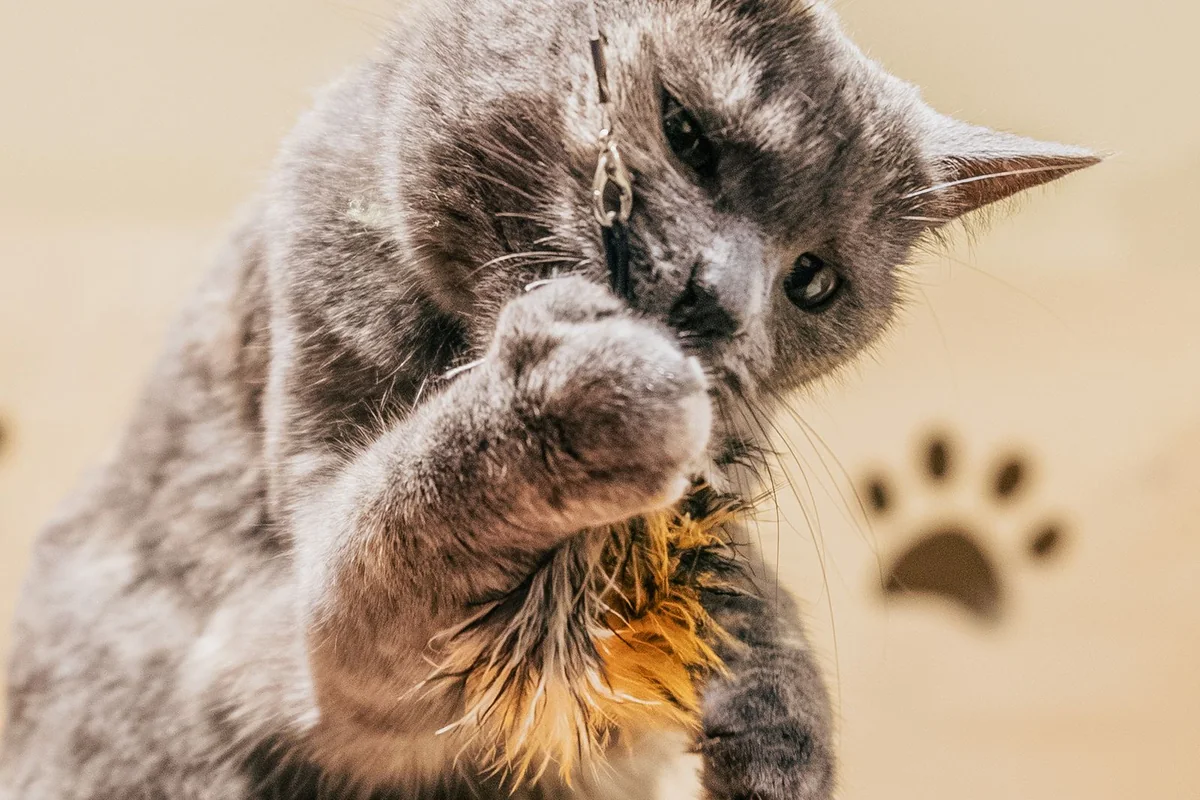
A cat can spend a minute looking away from a toy and still notice the exact moment it disappears behind a chair. Sometimes a person interprets that quiet minute as boredom, shakes the wand harder, and misses the first interested movement. The cat may have been waiting for the toy to go somewhere interesting all along.
Try moving a toy low and away from the cat, pause in a place where it remains visible or can be investigated, and let the cat catch it. Give your cat a chance to move voluntarily, including at the end of the game. A few good seconds can teach you more about your cat's preferences than a long performance.
Ask where the cat would start
Choose a time when your cat is awake and unoccupied. The hour just before a customary meal may work well if your cat is already active. Another cat may pay attention when the household gets quiet after dinner. Try one or two short sessions on an ordinary day. Leave mid-nap play for another time. A sleepy cat has already made a choice about what to do with the afternoon.
Notice where your cat is facing. If a cat is sitting behind the arm of a sofa, aim for a position where it can see the toy crossing an open stretch of floor without coming toward its face. The cat might only turn one ear at first. If it stays loose, give it time to look. If it flattens its ears, freezes tightly or moves away, stop or change the setup. A toy is supposed to give it a small opportunity, and it can decide whether to take it.
Make the area easy to use. Move the hard basket out of the turning path, push in the loose chair, and provide a runner on a floor where quick steps tend to slip. A cat may decline a perfectly interesting toy if following it means racing around a corner beside a curious dog. Separate household pets at first. If you want to understand what kind of play one cat likes, having the whole floor to itself is a good beginning.
Give the toy somewhere to go
A wand toy can look like an animal taking cover or like an object floating above the cat's head. You control that difference. Try a short trip along the floor, then a stop beside a sturdy box or a fold in a blanket. The movement gives the cat a path to cross. When the toy starts up again, stay within the cat's view for a beat before slipping around the edge.
There is room for several different kinds of movement. A felt toy might travel under a piece of packing paper that lies flat and has no handles or tape. A soft ball might roll into an empty cardboard tray with a low edge. A larger kicker toy can stay still once the cat grabs it. Choose intact toys sized and built for cats, skip tiny loose parts that can be swallowed, and check stitching, attachments and cords regularly.
Avoid treating every glance as a race to win. If the cat catches the wand attachment, release the pressure on the line and let it hold the toy. Where it is safe, allow a moment for pawing or mouthing under supervision. Once the cat looks away, you can move it again. A cat that repeatedly gets close without a catch may lose interest, or it may start grabbing for an alternative that is easier to reach.
Give your cat choices about height. Some cats enjoy a controlled low leap. Others engage longer if all four feet remain close to the floor. For cats with mobility limitations or recovery instructions, ask a veterinarian about suitable movement. Even a healthy young cat benefits from a clear landing and an easy exit from a game. Keep attachments away from the eyes and face, and keep sudden pulls from sending the animal into a hard edge or unstable furniture.
One useful experiment is to play the same floor route twice, moving less the second time. Watch for a whisker shift, a head tracking sideways, or a step off the sofa. That gives you an idea of how much movement the first game actually needed. Waiting through the pause also gives you time to see the little decision that precedes a chase.
Build a small session around the catch
Try five passes, without counting them as a goal your cat has to reach. The first can offer a slow approach and a pause. The next can be shorter if the cat moves closer. After a catch, wait. A few turns may be enough. End while the cat can easily return to ordinary activity, rather than continuing to move an attachment it has already stopped watching.
For households that feed on a routine, finish near an existing meal if that fits the cat. A small reward can come from the cat's regular food allowance where appropriate. Let the cat choose whether to eat now or settle a few steps away. If food has to be offered in a particular way for a medical reason, keep that arrangement in place. You can still end a toy game with a catch and a quiet break.
There are good reasons to notice what happens after play. Does the cat lie on its side nearby? Does it keep circling your ankles, looking for something else to chase? Does it jump repeatedly in the direction of a toy that has been put away? The answers can help you shorten a session or make the last catch easier. They may also tell you that changing the time or offering more than one short session would make the evening smoother.
For string, ribbons, lure wands and any toy with a cord, the end of the game includes putting the item in a secure place. String can be swallowed, and a hanging toy can catch on an animal or furniture. Store it somewhere the cat cannot open. If pieces are suddenly missing and you suspect swallowing, call a veterinarian promptly. Avoid pulling on string visible in your cat's mouth or elsewhere and follow the veterinary team's instructions.
If the usual game still falls flat
Consider the social part of the room first. A cat that lives with two others may wait for its own turn even when the other cats appear tolerant. One cat may take possession of the center of the carpet, leaving the second to watch from a chair. Try a closed door, a different household member and a fresh patch of floor. Play with each cat separately before deciding whether any of them likes the toy.
Texture can matter when movement looks promising. The light toy that bounces on a rug may make an unexpectedly hard sound on a tile floor. A cat that follows it with its eyes might like the same movement with something softer. Another may be more curious about a toy it can smell or paw out of a shallow open box. Offer the version that is easy to catch first. Variety does not have to involve a large collection.
If your cat chases hands or ankles, put distance between skin and the game. A wand can keep movement on the floor away from fingers during a normal session. When an ankle ambush happens, stop adding quick movement if it is safe to do so, then give the cat space to disengage. Build in the next planned game earlier than the usual ambush. Ask a veterinarian or an appropriate behavior professional for help if interactions are causing injuries, come on suddenly, or are hard to manage safely.
Be selective about games involving a moving dot of light. A tangible toy gives the cat something to catch, and it is easier to move a wand in a way that avoids faces and sharp stops. If a household already uses a light game, plan a real toy the cat can reach, keep light away from eyes and end with a tangible catch. If a cat continues searching for the point after the game, switch to something it can grab and hold.
Pay attention to changes across days. A cat who has never wanted to pounce in front of company may be acting normally while watching a guest play from a nearby chair. A cat who suddenly stops following a toy it usually loves, avoids even small movements, or has a change in appetite or other habits deserves a closer look. Share those observations with your veterinarian. The timing and circumstances can be more helpful than a general description of low energy.
Keep one detail from the afternoon
When a game goes well, make a small note for the next person who plays. It could be as simple as “fleece mouse beside the rug after dinner” or “stays interested if the toy pauses.” If a cat sitter will take over, show where the toy is kept and how the cat typically ends a session. People are more likely to offer the game when they can picture a short one that works.
Give the room back to the cat once play is over. Put the string toy away, leave the floor clear, and resist the urge to try just one more pass. Tomorrow's game can begin with the same little trip beside the sofa. This time you might notice the cat moving a paw into position long before either of you is ready for the chase.